We are envisioning a safer, more accessible, and connected future, together.
Reconnecting the East Side is not just a physical reconnect, but economic, community, residential, civic, and spiritual reconnection – not from one side of the highway to the other, but from the past to the future.
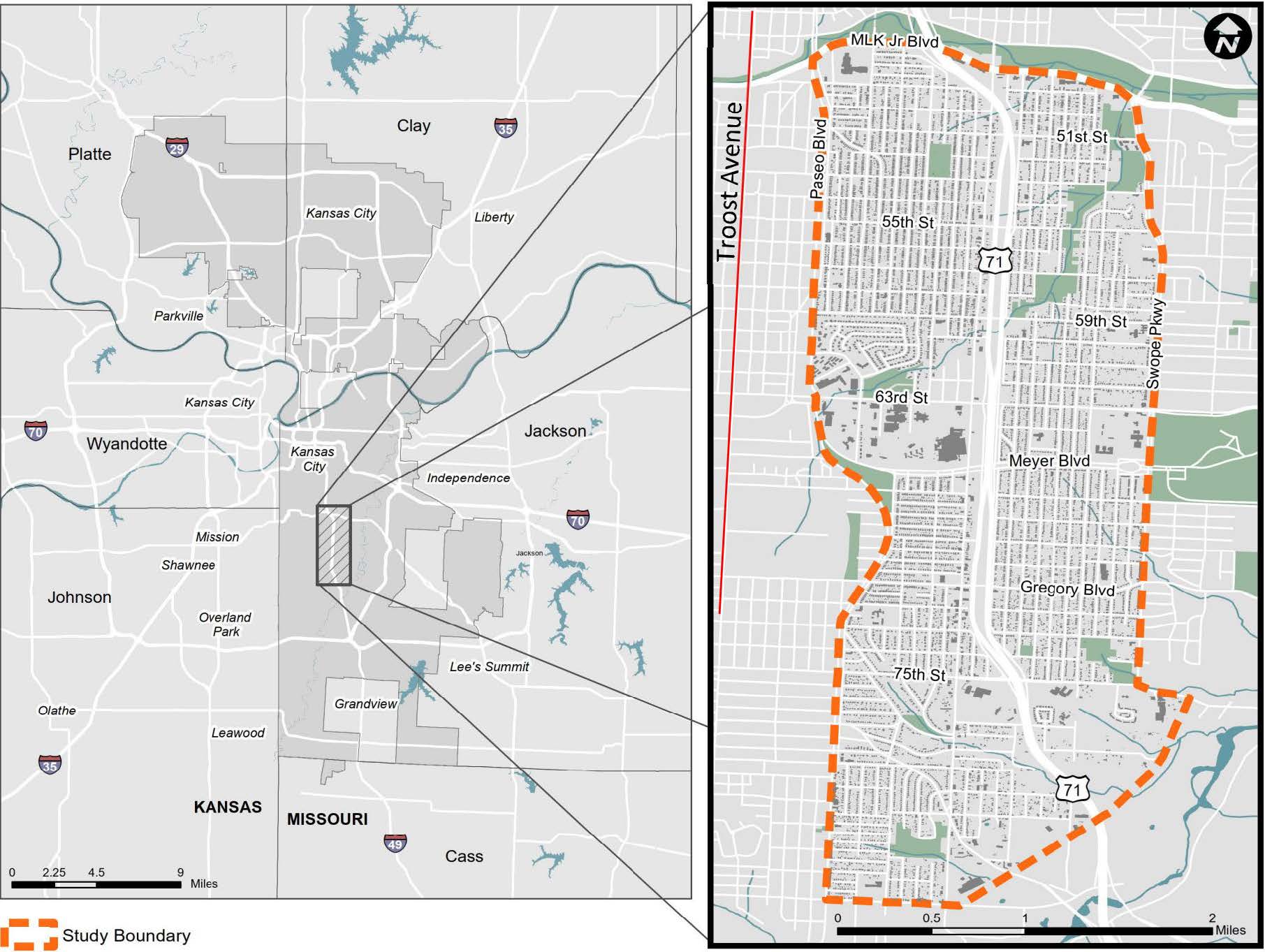
Focused on providing safe transportation improvements for the community, the Reconnecting the East Side project also aims to address some of the long-standing issues created when US-71 Highway construction divided neighborhoods, from Martin Luther King, Jr. Boulevard on the north to 85th Street on the south and from Paseo Boulevard on the west and Swope Parkway on the east.
Led by Kansas City, in partnership with the Missouri Department of Transportation (MoDOT) and the Mid-America Regional Council (MARC), this project is about more than roads – it is about physically restoring the heart of the East Side, by listening to its residents, identifying early action projects, and framing a long-term vision that can be implemented over the coming years.
Working hand in hand with the community, the project team is developing a comprehensive understanding of land use, green space, housing, economic development, public health, education, traffic safety, and other issues. Strategies for change will be identified to address the corridor’s needs.
Let's Build a Better US-71
Highlights from 2025:


Make your voice heard!
Your input will help guide planning, to reflect the needs of impacted neighborhoods and corridor users. Add your comments to our Engagement Map.
Frequently Asked Questions
Please use the dropdown arrows below to see frequently asked project questions.
If you don’t see your question here, we invite you to contact our project team.
The Reconnecting the East Side project is the first step in addressing challenges created when US-71 was constructed.
The project scope includes performing extensive community engagement and communications efforts while conducting a thorough analysis of the corridor to develop potential solutions. The point of this project is to chart a course toward a safer, more accessible, and connected community.
The project team will work with the community to develop a comprehensive understanding of land use, green space, housing, economic development, public health, and other issues. Strategies for change will be identified to address the needs within the corridor.
The project team is placing emphasis on comprehensive community engagement and collaboration to ensure the alignment of project outcomes with community needs and aspirations.
In recognition of the importance of inclusive, community-informed decision-making, the project approach will seek to hear all voices, including those who were displaced and those who remain, those who originally organized in opposition to the highway and their descendants. Marginalized, historically under-represented, and disadvantaged community members will be reached in culturally appropriate ways. Non-English-speaking residents and low-income community members will also be included.
The project team is planning and implementing a wide range of strategies, from listening to and gathering the stories of the community, acknowledging the history of US-71, to hosting a series of summits and using innovative pop-up events and outreach tools.
The project team will staff the Reconnecting the East Side Project Office for community members to drop by, ask questions and share their story.
Project Office
Mary Williams-Neal Community Center
3801 Emanuel Cleaver II Boulevard
Kansas City, MO 64130
Office Hours
Monday through Friday | 2 – 6 p.m.
In this work to re-imagine the neighborhoods and community fabric of the US-71 corridor, the project team is meeting community members where they are to best engage, collaborate, and empower them. Feedback and insights that are gathered through this framework and approach are instrumental to shape the direction and final recommendations of the project, reaffirming the commitment to building physical and human infrastructure that serves the collective interests of the community.
Funding for the first two phases of the Reconnecting the East Side project is primarily provided through a $5 million federal Rebuilding American Infrastructure with Sustainability and Equity (RAISE) grant, with additional funding support in the amount of $2.5 million from the City of Kansas City, Missouri, and MoDOT.
This funding enables the first phase of the project, a Planning and Environmental Linkages (PEL) Study, as well as the second phase to address the 1985 Federal Consent Decree.
When these first two phases are completed successfully, the third phase of the project can begin for the National Environmental Policy Act (NEPA) review process and preliminary design of the improvements the community may call for in the first phase, potentially including safer roadway crossings, better infrastructure for vulnerable road users like pedestrians and cyclists, more green spaces, and enhanced access to essential services.
At this time, no funding is available for design and construction of improvements along US-71 but continued planning and coordination is necessary if and/or when funding becomes available. The City and MoDOT will coordinate on how to fund safety improvements along US-71 in a way that meets the project’s Purpose and Need Statement along with additional community goals. Example funding options may involve pursuing federal grants, shifting US-71 to the Missouri Statewide Transportation Improvement Program’s list of funded projects, establishing public-private-philanthropic partnerships, and more.
Note: US-71 is currently on MoDOT’s Unfunded Needs List.
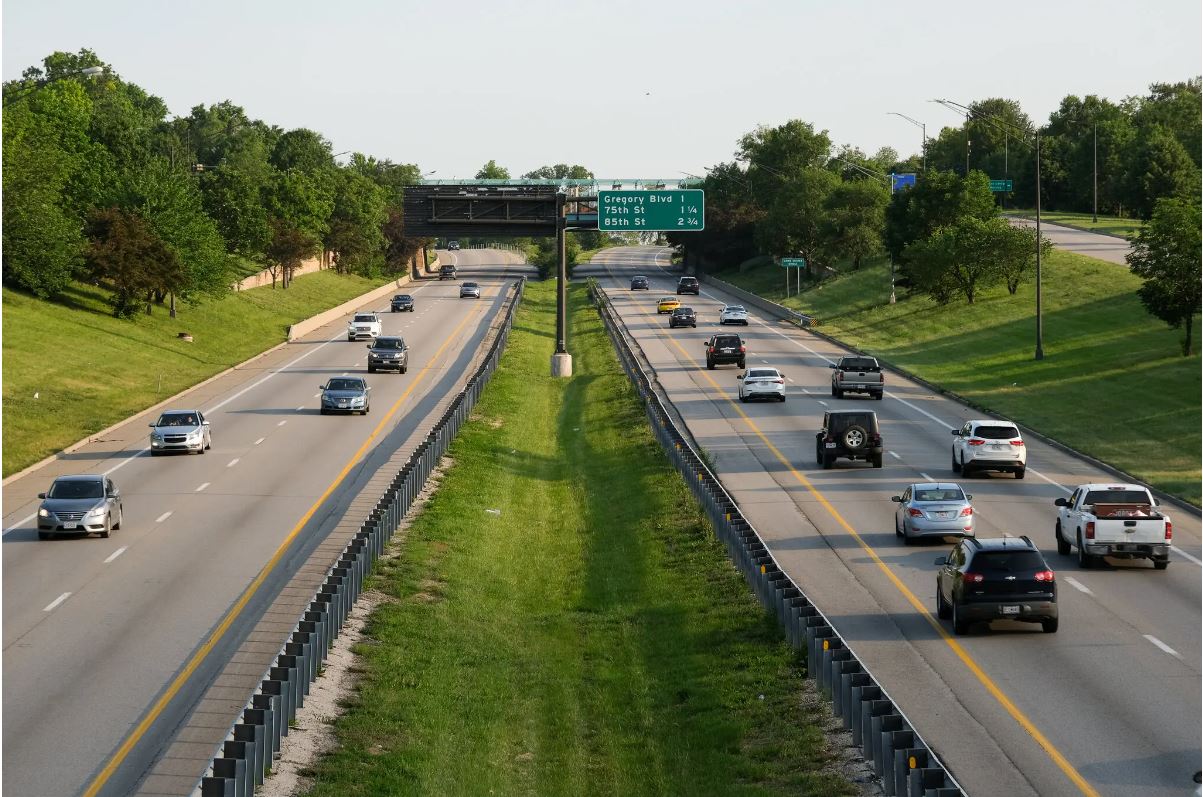
US-71 Highway divides a once-connected community, with few opportunities to cross it by car or on foot. The distances between crossings – a half mile on average – add significant time to a pedestrian’s travel time. Far too many pedestrians have been killed or seriously injured while trying to cross US-71, even at legal crossing locations.
Traffic lights have failed to spur the local economic development that was desired. There are many challenges to address in this corridor. The taking and demolition of thousands of predominantly African American homes, schools, churches and businesses to make way for the highway is only part of the long-term impacts.
In 2022, the City adopted its Vision Zero Action Plan. The plan documents that since 2010, there has been a 37% increase in crashes in Kansas City, and the brunt of this increase has occurred in low-income and minority communities. The plan identifies that the five-mile corridor encompassing the Reconnecting the East Side project sees the highest crashes for pedestrians and cyclists in the entire city. The US-71 corridor, as well as Prospect Avenue directly to the west, and Gregory Boulevard as it crosses US-71, were all identified as Top Priority High Injury Network (HIN) corridors and intersections.
Improving safety of the US-71 corridor is a primary focus of this project as there are many residents who cross the corridor by foot, bicycle, and mobility device, who are considered vulnerable road users. As part of the Reconnecting the East Side project, traffic calming measures, access to basic infrastructure like safer crossings and connected sidewalks, vulnerable-road-user-friendly designs, and updated roadway infrastructure will be explored.
Kansas City is managing the Reconnecting the East Side project in collaboration with the Missouri Department of Transportation (MoDOT) and Mid-America Regional Council (MARC). The City and its Hg Consult-led consultant team are coordinating closely with the Federal Highway Administration (FHWA), MoDOT, MARC, and other regulatory agencies.
Although these agencies are partnering to manage this project, the community will play a key role in leading the conversation and deciding on the future of the US-71 corridor.
The Reconnecting the East Side project is still in its early stages where much of the important investigative work will be completed, and the project scope of work will progress through three phases on the following timeline:
- Phase 1 (Fall 2024 – Spring 2026):
Developing a Planning and Environmental Linkages (PEL) Study - Phase 2 (Fall 2025 – Fall 2026):
Addressing the 1985 Federal Consent Decree - Phase 3 (2027 – 2028):
Advancing to the National Environmental Policy Act (NEPA) review process and Preliminary Design
This timeline is subject to change as the Reconnecting the East Side project evolves.
When the Phase 3 NEPA review process and Preliminary Design is complete, a Final Design Phase could commence, which could lead to a future Construction Phase. At this time, there is not an anticipated schedule for either the Final Design or Construction Phases, and there is no funding identified for Final Design on Construction.
A Planning and Environmental Linkages (PEL) Study is a Federal Highway Administration (FHWA) process used to plan solutions for transportation issues, priorities, and environmental concerns. It is a decision-making tool supported by planning analyses that intends to streamline overall project delivery. PEL planning activities and analyses include the following: safety, economic benefits, transportation effects, natural and built environment effects, and implications for land use and community engagement.
The Missouri Department of Transportation anticipates incorporating recommendations made as part of the PEL study into future National Environmental Policy Act (NEPA) studies, per Title 23 of the US Code, Part 168. The NEPA regulations encourage agencies to take appropriate advantage of existing documents and studies, like PEL, through adoption, use, and incorporation by reference during the NEPA phase, which for this project is anticipated as Phase 3 (Fall 2026 – Fall 2028) when the city will advance to the NEPA review process and refine the conceptual design solutions.
US-71 is unique among urban highways. It started like so many others, with nation-wide interstate highway planning and construction, 70 years ago but was delayed and significantly altered due to organized community resistance.
A compromise solution resulted from the 1985 Federal Consent Decree, whereby US-71 was to be built as “less than a highway and more than a parkway.”
The highway was finally opened for operation in 2001, and in the 24 years since it opened, several of the stated benefits of the highway and compromise solution of the Federal Consent Decree have failed to materialize. In addition, new traffic safety issues and barriers to mobility for neighborhoods on the east side of Kansas City, Missouri, have arisen. The decree requires the retention of three signalized, at-grade crossings and imposes specific legal guidelines for any substantial reconfiguration of the US-71 corridor.
Addressing or resolving the decree is a key focus of Phase 2 of the Reconnecting the East Side project to allow for transformative solutions. The project team will work with legal counsel to enable transformative solutions that prioritize safety, connectivity, and community needs.
Learn More about the history of US-71
The 1985 Federal Consent Decree is available at the National Archives, which is located at 400 West Pershing Road, Kansas City, MO 64108. They can be reached by phone at 816-268-8000. It is also available online via the Kansas City Public Library.
The National Environmental Policy Act (NEPA) requires federal agencies to assess the environmental effects of their proposed actions prior to making decisions.. The NEPA process for the Reconnecting the East Side project will take place in Phase 3 and will identify potential impacts of refined alternatives that are developed in Phase 1 of the project, as well as mitigations to air quality, natural habitats, protected species, socioeconomics, the built environment, soils and farmland, hazardous materials and more. For more information about NEPA, visit the American Association of Highway and Transportation Officials (AASHTO) website or the FHWA’s website. The FHWA NEPA process allows transportation officials to make project decisions that balance engineering and transportation needs with social, economic, and natural environmental factors.
The Reconnecting the East Side Planning and Environmental Linkages (PEL) Study will focus on two distinct areas:
- An Area of Influence: The project’s area of influence is bounded by Paseo Boulevard to the west, Swope Parkway to the east, Martin Luther King, Jr. Boulevard to the north and East 85th Street to the south.
- An Area of Potential Effect: The project’s area of potential effect includes the US-71 right-of-way between Martin Luther King, Jr. Boulevard and East 85th Street plus a narrow buffer on either side of US-71. This area is intended to be wide enough (plus about 50 feet in either direction) to cover any potential improvement strategy and potential construction limits.
See the map HERE.
The project team is working hand in hand with the community on this project:
- Project Ambassadors: elected officials and leadership in the region
- Community Advisory Group (CAG): neighborhood representatives, advocates, and others
- Technical Advisory Group (TAG): City departments and public agencies
- The broader community: develop a comprehensive understanding of corridor issues — land use, green space, housing, economic development, public health, education, and others.
Then, this collective will work together to identify strategies, improvement concepts, and initial and refined alternatives that meet the US-71 corridor’s needs.
Community members will also have opportunities to engage through Neighborhood Listening Sessions, pop-up events, and four Community Summits beginning in 2025.
The community can get involved in this project in a variety of ways:
- Sign up for updates and receive information on this project website to learn more about upcoming Neighborhood Listening Sessions, Community Summits, and other community engagement events.
- Visit the project website for news and announcements.
- Join community Neighborhood Listening Sessions, which are local neighborhood meetings and Third and Fifth District meetings when project team members are scheduled to attend and hear your feedback – beginning in January 2025.
- Join the project’s four (4) Community Summits the project team will convene to share more information about the project and seek your input on all aspects of the project, beginning in February 2025.
- Community Summits provide an opportunity for residents to share input, explore design alternatives, and collaborate on solutions. They are critical for ensuring the project reflects community priorities.
- Follow, share, and stay engaged with us on our social media channels
The 1985 Federal Consent Decree is available at the National Archives, which is located at 400 West Pershing Road, Kansas City, MO 64108. They can be reached by phone at 816-268-8000. It is also availbile online via the Kansas City Public Library at https://kchistory.org/document/final-judgement-and....
The boundaries of US-71 Reconnecting the East Side were determined in 2022 as part of the RAISE grant program agreement entered into by the Missouri Highways and Transportation Commission, which is governed by the Federal Highway Administration, U.S. Department of Transportation, and the City of Kansas City, Missouri. The corridor's safety issues, which were documented through the City's Vision Zero initiative and concentrated between Martin Luther King, Jr. Boulevard and 85th Street, were among the top factors contributing to the grant award.
As a result, Reconnecting the East Side focuses on the US-71 corridor from Martin Luther King, Jr. Boulevard on the north to 85th Street on the south. The broader study area boundaries are Martin Luther King, Jr. Boulevard on the north, 85th Street on the south, Paseo Boulevard on the west, and Swope Parkway on the east. The City and MoDOT recognize areas outside the boundaries also have transportation safety concerns, but the existing grant does not cover areas beyond Reconnecting the East Side's boundaries.
See the map HERE.
View Grant Document HERE.
Prospect Avenue is a major north-south route within the US-71 Reconnecting the East Side study area. Kansas City, MARC, and community-driven Prospect Avenue efforts include those listed below and are being taken into consideration as improvements for US-71 are explored.
- Swope-Prospect Connectivty Study: Will create a more inclusive, sustainable, and accessible transportation network for the communities along the Prospect Avenue corridor. It aimed to improve quality of life, reduce transportation barriers, and support economic growth by improving mobility options for residents and visitors alike. By addressing issues such as safety, pedestrian infrastructure, and transit services, the study sought to promote access to key amenities and foster better connectivity across the area.
- ProspectUs Equitable Transit-Oriented Development (TOD) Strategic Plan: Focuses on Prospect Avenue from 12th Street to 77th Street, the plan is anticipated to add 40,000 residents, 17,000 new homes, and 15,000 jobs to the area, leveraging Prospect MAX. Kansas City Resolution No. 250413 proposed the area receive a $500 million investment over 10 years with assistance from the Economic Development Corporation (EDC) of Kansas City, and on February 27, 2025, the Kansas City Council adopted the ProspectUs Strategic Plan.
- Prospect Avenue Safety Improvements: A total of $10 million in Safe Streets and Roads for All federal grant funds to design and construct safety improvements on Prospect Avenue from Linwood Boulevard to Emanuel Cleaver II, Boulevard was awarded in early 2025. Design is anticipated to occur in 2026 and construction is anticipated in 2027. “Kansas City has the fourth highest fatal crash rate in the country and Prospect Avenue is one of the most dangerous corridors in the area.”
Existing plans and studies relevant to the study areas and beyond, such as ProspectUs, Hickman Mill-Prospect Corridor Plan, and Ride KC Next Comprehensive Transit Service Analysis are included within the detailed list at https://reconnecteastside.com/city-projects.
At this time, no funding is available for design and construction of improvements along US-71 but continued planning and coordination is necessary if and/or when funding becomes available. The City and MoDOT will coordinate on how to fund safety improvements along US-71 in a way that meets the project’s Purpose and Need Statement along with additional community goals. Example funding options may involve pursuing federal grants, shifting US-71 to the Missouri Statewide Transportation Improvement Program’s list of funded projects, establishing public-private-philanthropic partnerships, and more. Note: US-71 is currently on MoDOT’s Unfunded Needs List.
The outcomes of US-71 Reconnecting the East Side include the identification of no-build and build alternatives. No-build alternatives address maintenance and safety issues as a series of standard improvements funded via the City’s and/or MoDOT’s capital improvement budget. In contrast, build alternatives involve modifying existing infrastructure, new construction, and/or a combination of approaches.
The implementation timeline is subject to change as the Reconnecting the East Side project evolves. When the Phase 3 NEPA review process and Preliminary Design is complete, a Final Design Phase could commence, which could lead to a future Construction Phase. At this time, an anticipated schedule has not been identified for either Final Design or Construction Phases, and funding has not been determined for these potential future phases.
Impacts on commuting and travel times are dependent on the alternative selected for US-71 within the study areas. The project team is engaging in thoughtful analyses that will balance the needs of local residents and the region’s commuters.
IN MEMORIAM: Carrie E. Stapleton
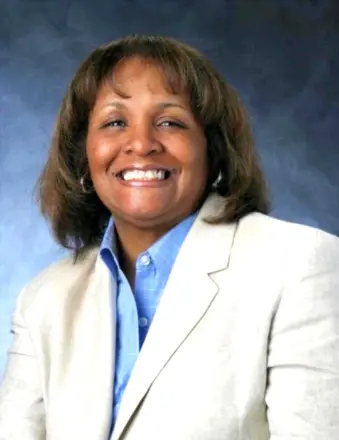 Carrie Stapleton, a pioneering Kansas City public relations professional, business owner, and tireless community advocate, passed away peacefully on April 18, 2026. She was 72 years old. Read more in the Kansas City Star.
For more than four decades, Carrie helped shape how Kansas City told its stories—amplifying community voices, advancing civic initiatives, and building bridges across business, government, and grassroots organizations. Through her firm, Phillips-West Public Relations & Communications, she became one of the region’s most respected communications strategists, known for her deep media relationships and unwavering commitment to community impact.
Carrie founded Phillips-West Public Relations & Communications in 1988 as a full-service African American/woman-owned public relations, advertising, marketing, and special events firm serving local and national clients. The firm’s services included media planning and execution, internal and external public relations, public relations in the marketplace, publicity staging, marketing and promotions, graphic arts and design, creative press kits, crisis media management, speech writing, special events, public meetings and hearings, professional networking, governmental relations, entertainment planning, street teams, multi-cultural programming, videography, photography, and athlete and artist management.
Carrie leaves behind a lasting legacy in Kansas City—one built on storytelling, service, and a steadfast belief in the power of community. The entire Reconnecting the East Side Project Team extend sincerest condolences to Carrie's family, friends and loved ones. Carrie, you are dearly missed, and we will not forget what you taught us all.